
A modern front-end over Moodle, without losing Moodle underneath.
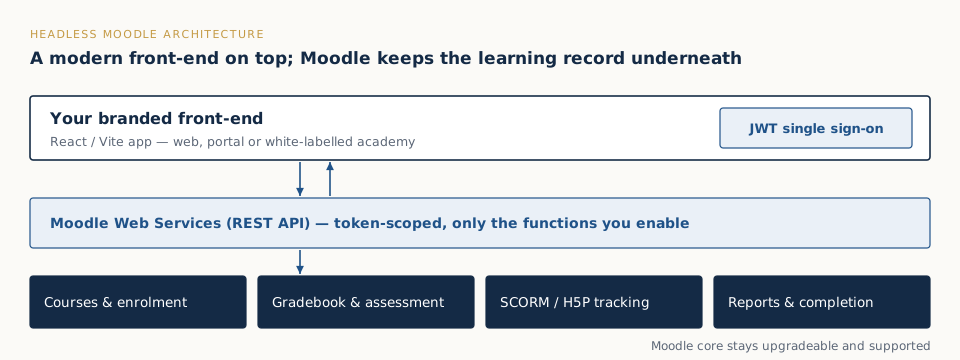
A branded React/Vite front-end that talks to Moodle through its Web Services REST API, with single sign-on. Moodle keeps running courses, grading, tracking and reporting behind it.
From $6,500Plus an ongoing Care PlanReact / Vite + Moodle REST API
Headless Moodle means using Moodle as the back-end learning engine and building your own front-end on top of it. Learners use a fast, branded web app; Moodle still stores enrolments, grades, completion and SCORM/H5P tracking. UTSL builds this as a Headless UX Kit: an API audit, JWT single sign-on and a React/Vite front-end, from $6,500 plus a Care Plan.
What “headless Moodle” means
A standard Moodle site renders its own pages with its theme. In a headless setup, a separate front-end application handles everything the learner sees and calls Moodle in the background through Moodle Web Services, its token-based REST API. Moodle remains the system of record; the front-end becomes the product experience.
Why organisations go headless
- Brand and product experience. Training companies selling courses want the learning portal to look like the rest of their product, not like an LMS.
- One sign-in. Learners move between your platform and their courses without a second login.
- Different journeys for different audiences. A simple mobile-first view for learners, a separate view for managers or partners, both backed by the same Moodle.
- Keep what already works. Gradebook logic, quiz engines, SCORM/xAPI tracking, completion rules and reports stay in Moodle, where they are already trusted and audited.
The alternative, replacing Moodle with a custom LMS, means rebuilding all of that. Headless gets most of the experience benefit for a fraction of the risk.
What the Headless UX Kit includes
1. API audit
We map the screens and workflows you want against Moodle’s Web Services functions. Most needs, such as course listings, enrolments, grades and completion, are covered by core functions. Where they aren’t, we write a small Moodle plugin that exposes exactly what’s needed, with its own capability checks.
2. Single sign-on
JWT-based single sign-on between your front-end and Moodle, so learners authenticate once. We have built this pattern before, integrating Moodle with an external intern platform.
3. Front-end build
A React/Vite application styled to your brand and deployed however you already deploy front-ends, whether that is Vercel, AWS or your own servers. Learners can still open a full Moodle activity (a SCORM package or a quiz, for example) when the experience needs Moodle’s native player.
4. Care Plan
A headless build adds a moving part that needs watching across Moodle upgrades, so every Headless UX Kit runs alongside an ongoing Care Plan.
Security and API design
- Web Services tokens are scoped to a dedicated service that exposes only the functions the front-end needs.
- Moodle’s capability and role checks still apply to every call.
- Secrets stay server-side; the browser never holds an admin token.
Before you start
A headless build only makes sense on a Moodle release whose API you can rely on for the next few years. If your site is on an older version, we usually recommend upgrading to Moodle 5.3 LTS first. A Health Check tells you where you stand.
Headless Moodle FAQ
What is headless Moodle?
Headless Moodle uses Moodle as a back-end learning engine while a separate front-end application, such as a React app, provides the user interface. The front-end talks to Moodle through Moodle Web Services, its REST API, so courses, grades and tracking still live in Moodle.
How much does a headless Moodle front-end cost?
UTSL’s Headless UX Kit starts from $6,500, plus an ongoing Care Plan from $290 per month. The final price depends on the number of screens, integrations and any custom API functions needed.
Does Moodle have a REST API?
Yes. Moodle Web Services expose a large set of functions over REST using a token. Administrators enable a service, choose which functions it exposes and issue tokens for it. Missing functions can be added with a small local plugin.
Can learners still use SCORM, H5P and quizzes?
Yes. Tracking stays in Moodle. Where an activity needs Moodle’s own player, the front-end can open it inside the Moodle context with single sign-on, so the learner doesn’t log in twice.
Will a headless front-end break when we upgrade Moodle?
Web Services functions are versioned and change slowly, but upgrades still need checking. That is why every Headless UX Kit runs with a Care Plan, and why we recommend building on Moodle 5.3 LTS.
Want to see what’s possible on your API?
We’ll look at your Moodle version and Web Services setup before quoting a Headless UX Kit.